

👉 Want to test your reasoning speed under the real 15-minute sectional clock? Take a free SSC CGL sectional mock test →
Updated: September 2026 · Based on SSC CGL PYQ analysis (2016–2025)
Blood relation questions feel confusing only because people try to hold the whole family in their head. Stop doing that. The moment you draw a tiny family tree, every question — single relation, coded, or “pointing to a photograph” — turns into a picture you can simply read. This guide gives you one visual method that works everywhere, plus a complete English–Hindi relation table you won’t find in the usual guides. It works for SSC CGL and every other government exam that asks these questions.
Quick answer: Solve every blood relation question by drawing a family tree using a fixed notation — a square for male, a circle for female, a horizontal line for marriage, and a vertical line from parent to child. Place each person as you read the sentence, then read the final relation straight off the diagram. Never assume gender unless it’s stated.
On this page:
- What blood relation questions test
- The universal notation (turn any sentence into a tree)
- Relation ready-reckoner — every relation in English & Hindi
- Type 1 — Single-relation questions
- Type 2 — Coded blood relations
- Type 3 — Pointing to a photograph
- Type 4 — Dialogue & jumbled family
- The generation-level shortcut
- Speed tips
- Most-repeated patterns
- Common mistakes that cost marks
- Practice mini-set (self-test)
- FAQs
What blood relation questions test
You’re given a chain of relationships and asked how two people are connected. SSC (and banking, railway, state PSC exams) keeps the maths at zero — the whole skill is translating words into a diagram without losing track of who is male, who is female, and which generation they sit in. Learn one clean notation and you’ll never re-read a question twice.
The universal notation (turn any sentence into a tree)
Use these four symbols for every question. Write them on your rough sheet before the section starts.
Here’s the notation in action — a simple two-generation family:
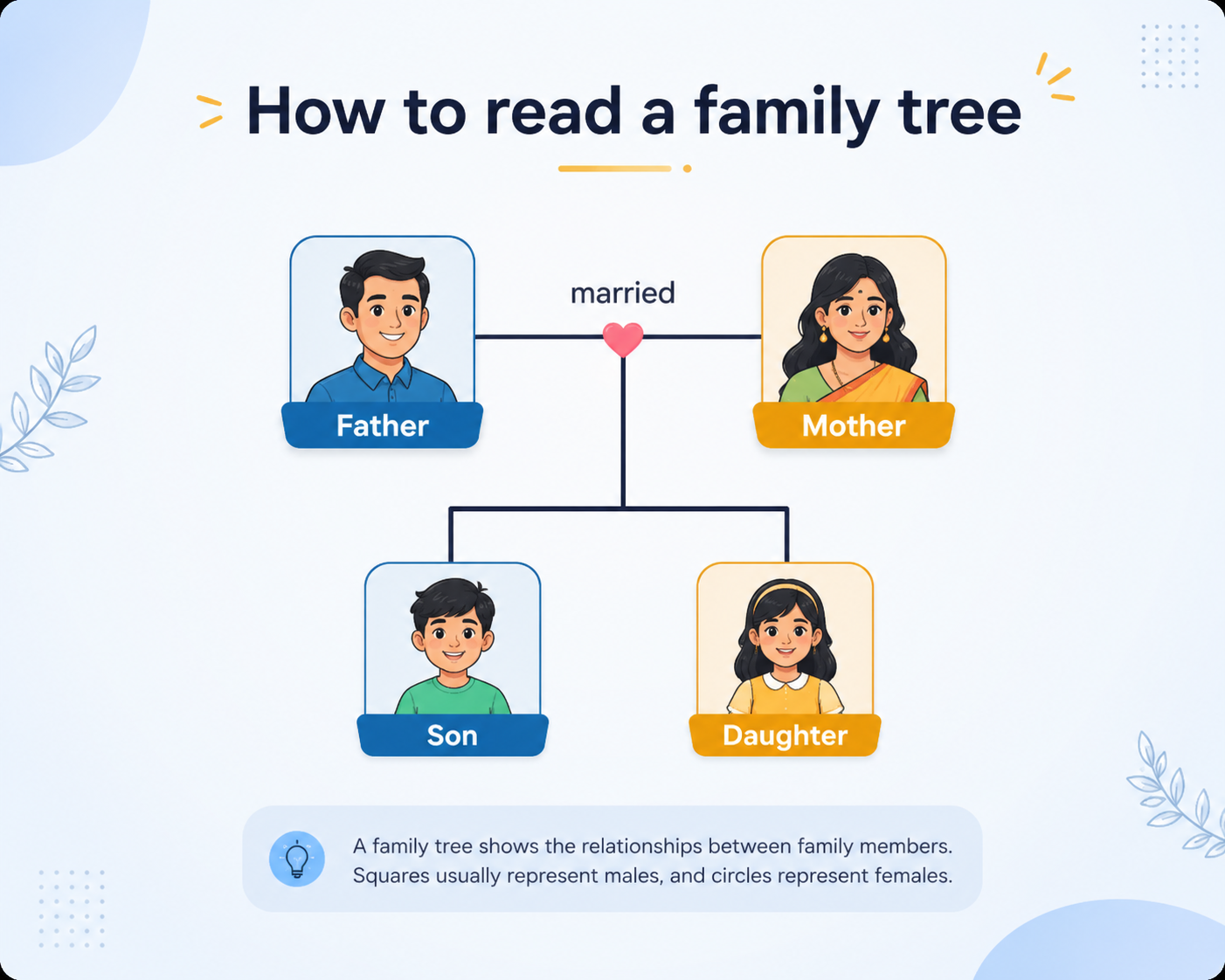
Two parents joined by a marriage line, with a branch down to each child. Every question becomes a picture like this.
Relation ready-reckoner — every relation in English & Hindi
This is the single most useful table to memorise. It maps each relationship to its exact English term and its Hindi term — so whichever way the question (or the option) is worded, you’ll recognise it instantly.
| Relationship | English term | Hindi term |
|---|---|---|
| Father’s father | Grandfather (paternal) | दादा (Dada) |
| Father’s mother | Grandmother (paternal) | दादी (Dadi) |
| Mother’s father | Grandfather (maternal) | नाना (Nana) |
| Mother’s mother | Grandmother (maternal) | नानी (Nani) |
| Father’s brother | Paternal uncle | चाचा / ताऊ (Chacha / Tau) |
| Father’s sister | Paternal aunt | बुआ (Bua) |
| Mother’s brother | Maternal uncle | मामा (Mama) |
| Mother’s sister | Maternal aunt | मौसी (Mausi) |
| Brother’s wife | Sister-in-law | भाभी (Bhabhi) |
| Sister’s husband | Brother-in-law | जीजा / बहनोई (Jija / Behnoi) |
| Husband’s brother | Brother-in-law | देवर / जेठ (Devar / Jeth) |
| Husband’s sister | Sister-in-law | ननद (Nanad) |
| Wife’s brother | Brother-in-law | साला (Saala) |
| Wife’s sister | Sister-in-law | साली (Saali) |
| Wife’s / Husband’s father | Father-in-law | ससुर (Sasur) |
| Wife’s / Husband’s mother | Mother-in-law | सास (Saas) |
| Son’s wife | Daughter-in-law | बहू (Bahu) |
| Daughter’s husband | Son-in-law | दामाद (Damad) |
| Brother’s son | Nephew | भतीजा (Bhatija) |
| Brother’s daughter | Niece | भतीजी (Bhatiji) |
| Sister’s son | Nephew | भांजा (Bhanja) |
| Sister’s daughter | Niece | भांजी (Bhanji) |
| Son’s son | Grandson (paternal) | पोता (Pota) |
| Son’s daughter | Granddaughter (paternal) | पोती (Poti) |
| Daughter’s son | Grandson (maternal) | नाती / दोहता (Nati / Dohta) |
| Daughter’s daughter | Granddaughter (maternal) | नातिन (Natin) |
Type 1 — Single-relation questions
The most common form: a short chain, asked to find one relationship. Draw as you read.
Example. A is the mother of B. C is the father of B. B is the brother of D. How is C related to D?
Place A (mother, circle) and C (father, square) as a married pair. B and D are children of this pair (B is D’s brother, so same parents). D is C’s child → C is the father of D.
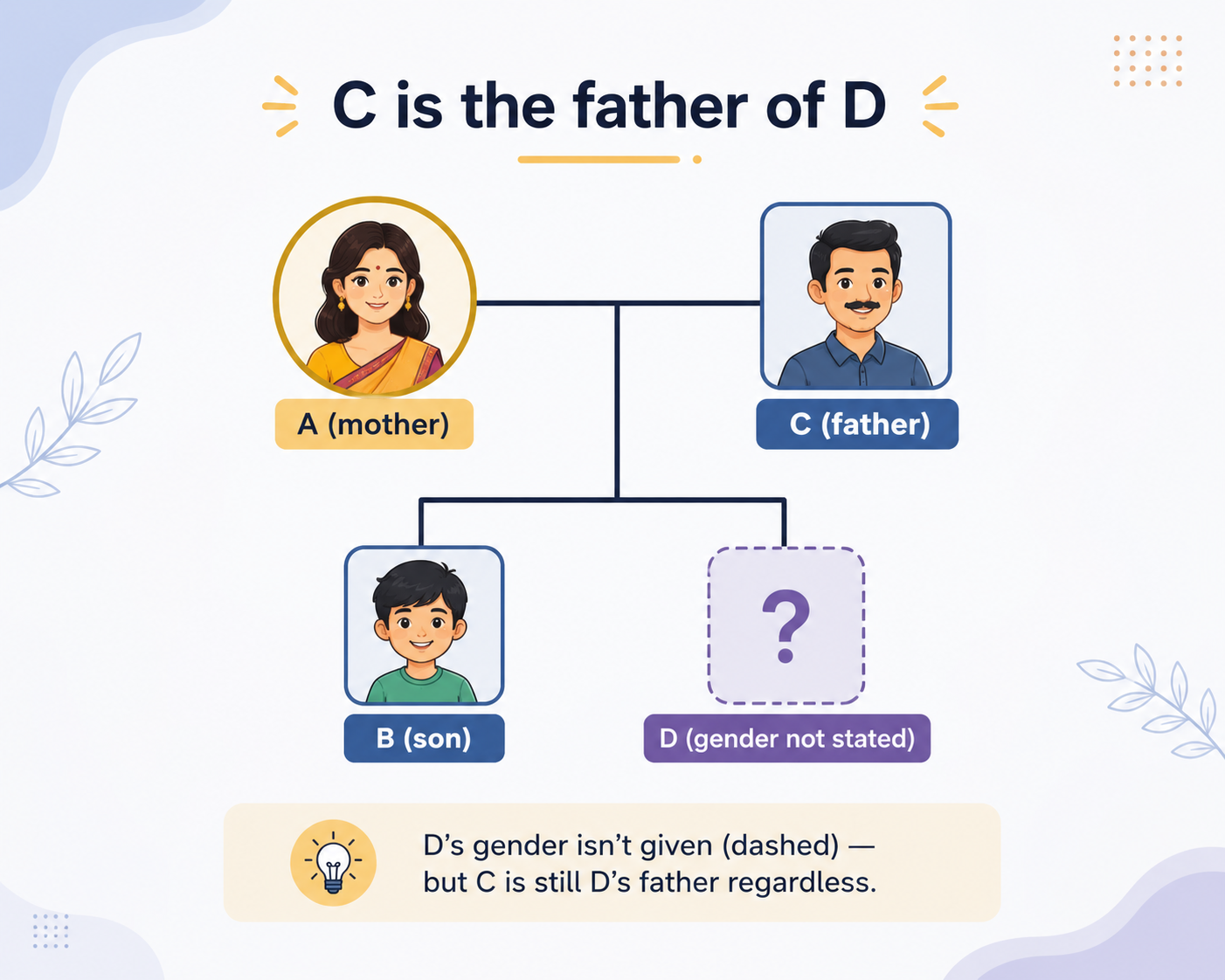
D’s gender isn’t given (dashed) — but C is still D’s father regardless.
Type 2 — Coded blood relations
Symbols replace the relationship words. The exam always gives you a legend — decode it symbol by symbol, then draw.
Example legend: “P × Q” = P is the father of Q · “P + Q” = P is the sister of Q · “P − Q” = P is the mother of Q · “P ÷ Q” = P is the brother of Q.
Question: What does “A × B ÷ C” tell you about A and C?
“A × B” → A is the father of B. “B ÷ C” → B is the brother of C, so B and C are siblings with the same parents. Therefore A is also the father of C → A is the father of C.
Golden habit: read a coded chain strictly left to right, converting each symbol into a line on your tree before moving on. Never try to decode the whole string in your head.
Type 3 — Pointing to a photograph
Here the speaker describes someone in a photo. The rule: start from the speaker and move outward exactly as the sentence says.
Example. Pointing to a photograph, Neha said, “This man’s son is my father’s brother.” How is the man related to Neha?
“My father’s brother” is Neha’s paternal uncle. That uncle is “this man’s son” — so the man is the uncle’s father. The uncle’s father is also Neha’s father’s father → the man is Neha’s grandfather (dada).
Watch the direction. “X’s son” means go down a generation from X; “X’s father” means go up. Mixing these up is the number-one error in photo questions.
Type 4 — Dialogue & jumbled family
Longer puzzles give several statements about a group. Don’t solve linearly — build one big tree, adding each person as a new box or circle, and only read the answer once everyone is placed. Fix genders as they’re stated, and leave a dashed shape for anyone whose gender is unknown so you don’t assume it.
Turn this method into exam speed 🎯
Blood relations are easy marks — but only if you can draw the tree in seconds under pressure. The reasoning section is a fixed 15-minute lock with no going back, so timed practice is everything. Try a free sectional mock and see your real speed.
The generation-level shortcut
For “how is X related to Y” questions, tag each person with a generation number: grandparents = +2, parents = +1, self/siblings/spouse = 0, children = −1, grandchildren = −2. The difference in levels tells you the relation type at a glance — same level means sibling/spouse/cousin, one level up means parent/uncle/aunt, two levels up means grandparent. Then just fix the gender. This alone kills most “confusing” questions.
Speed tips
- Draw, don’t think. The tree is faster than mental tracking every single time.
- Never assume gender. “Brother of the doctor” doesn’t make the doctor male. Leave it dashed until stated.
- Mark the speaker. In photo/dialogue questions, circle the speaker first and build outward.
- Use generation levels to convert a messy chain into a clean up/down count.
- Keep the reckoner terms ready — many wrong answers are just the right relation with the wrong label.
Most-repeated patterns
Based on a trend analysis of SSC-style reasoning papers (2016–2025). Treat the weighting as a PYQ-trend estimate — SSC publishes no official topic weightage — not a guarantee.
| Pattern | How often (trend) | Best approach |
|---|---|---|
| Single-relation chain | Very high | Family tree |
| Coded blood relation | High | Decode legend + tree |
| Pointing to a photograph | High | Build outward from speaker |
| Dialogue / jumbled family | Medium | One combined tree |
| Generation / “how related” | Medium | Generation levels |
Common mistakes that cost marks
- Assuming gender from a role. Doctor, engineer, teacher — none imply male or female.
- Reversing direction in photo questions (“X’s son” is down, “X’s father” is up).
- Solving in your head instead of drawing — the source of most avoidable slips.
- Confusing maternal and paternal — mother’s side vs father’s side changes the Hindi term and sometimes the option.
- Picking a right relation with the wrong label — “nephew” vs “niece”, “brother-in-law” vs “son-in-law”.
Practice mini-set (self-test)
Draw the tree first, then tap to reveal the answer.
Q1. A is the son of B. B is the sister of C. C is the mother of D. How is A related to C?
Show answer
Nephew. B is A’s mother (A is B’s son). C is B’s sibling, so C is A’s aunt/uncle; A is C’s nephew (since A is male).
Q2. Pointing to a woman, a man said, “She is the daughter of my grandfather’s only son.” How is the woman related to the man?
Show answer
Sister. Grandfather’s only son = the man’s father. The daughter of the man’s father is the man’s sister.
Q3. Legend: “P + Q” = P is the husband of Q; “P − Q” = P is the daughter of Q. What does “M − N + O” say about M and O?
Show answer
M is the daughter of O. “M − N” → M is the daughter of N. “N + O” → N is the husband of O, so O is the wife (mother). Since M is N’s daughter and N & O are the married couple, M is also O’s daughter — so O is M’s mother.
Q4. X is the brother of Y. Y is the daughter of Z. Z is the wife of W. How is W related to X?
Show answer
Father. Y is Z and W’s daughter; X is Y’s brother, so X is also their child. W is X’s father.
Q5. What is the Hindi term for your mother’s brother?
Show answer
मामा (Mama) — the maternal uncle. (Father’s brother is चाचा/ताऊ.)
Frequently asked questions
What is the fastest way to solve blood relation questions?
Draw a family tree using a fixed notation — square for male, circle for female, horizontal line for marriage, vertical line for parent to child. Placing each person as you read the sentence is far faster and safer than tracking the family in your head.
How do I solve coded blood relations?
The question always provides a legend for each symbol. Decode the chain strictly left to right, converting each symbol into a line on your tree before moving to the next, then read the final relation off the diagram.
How do I solve “pointing to a photograph” questions?
Start from the speaker and move outward exactly as the sentence says. Remember that “X’s son” moves down one generation and “X’s father” moves up one — reversing that direction is the most common mistake.
What is my mother’s brother called in Hindi?
Your mother’s brother is your maternal uncle, called मामा (Mama) in Hindi. Your father’s brother is चाचा or ताऊ (Chacha/Tau).
Should I assume gender from a person’s job in blood relations?
No. A doctor, engineer or teacher can be male or female. Never assign gender unless the question states it — leave that person’s shape undecided until you have direct information.
Is blood relations important for SSC CGL and other government exams?
Yes. It is one of the highest-frequency reasoning topics across SSC, banking, railway and state exams, and it is high-accuracy once you master the family-tree method — making it a reliable scorer in the 15-minute locked reasoning section.
📌 Related reading
👉 Ready to draw these trees at exam speed? Take a free SSC CGL sectional mock test →


Pingback: Direction & Distance Reasoning Tricks 2026: Method + Diagrams